
Every year someone asks us to "finally retire SSRS and move everything to Power BI." Most years, that's the wrong move.
The two tools solve different problems, and the confusion costs real money. Power BI is built for interactive analytics — let a person explore, slice, and ask the next question. SSRS, now Paginated Reports, is built for the opposite: a pixel-exact document that looks the same every time, prints cleanly, and stands up in an audit.
When you're producing a VAT return supporting schedule, a statutory annual financial statement pack, a payslip, or a tax invoice that has to satisfy SARS, you don't want a tile that reflows on a phone. You want page 3 to be page 3, every month, for seven years of retention.
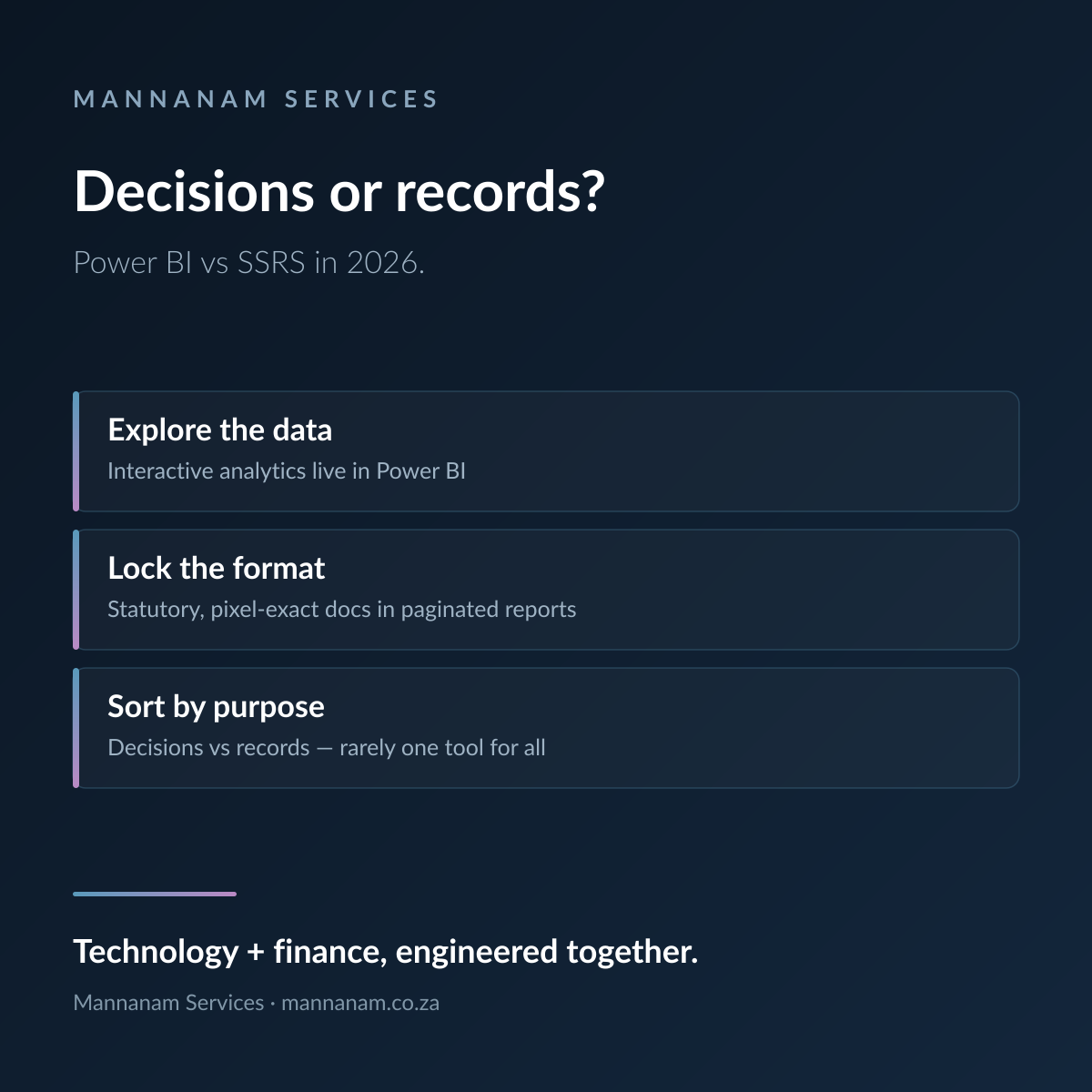
Decisions or records?
So the real architecture question isn't "which one wins." It's: which outputs are decisions, and which are records?
- Decisions — the CFO asking why margin moved — belong in Power BI.
- Records — the documents a regulator, auditor, or court will one day read — belong in paginated reporting.
Power BI's paginated capability now lets both live in one service, so at the platform level this isn't even an either/or.
Sort outputs by purpose, not by tool
The enterprises that get this right stop arguing about tools and start sorting outputs by purpose. The ones that get it wrong spend a year migrating statutory reports into a medium that was never designed to hold them — then quietly rebuild them when the auditors object.
Pick the tool that fits the output's job. Often, that's both.