
Here's a pattern worth recognising before you commission yet another dashboard.
Two reports show revenue for the same month. They disagree. Finance trusts one, Sales trusts the other, and the exec team trusts neither — so every meeting starts with twenty minutes of arguing about whose number is right instead of what to do about it. The instinct is to build a third, "definitive" dashboard. That usually just adds a third number.
It's a definitions problem, not a Power BI problem
Pull the two reports apart and you typically find: one counts revenue on invoice date, the other on payment date. One includes VAT, the other strips it. One quietly excludes intercompany, the other doesn't. Both are "correct" — they're answering different questions that happen to share a label.
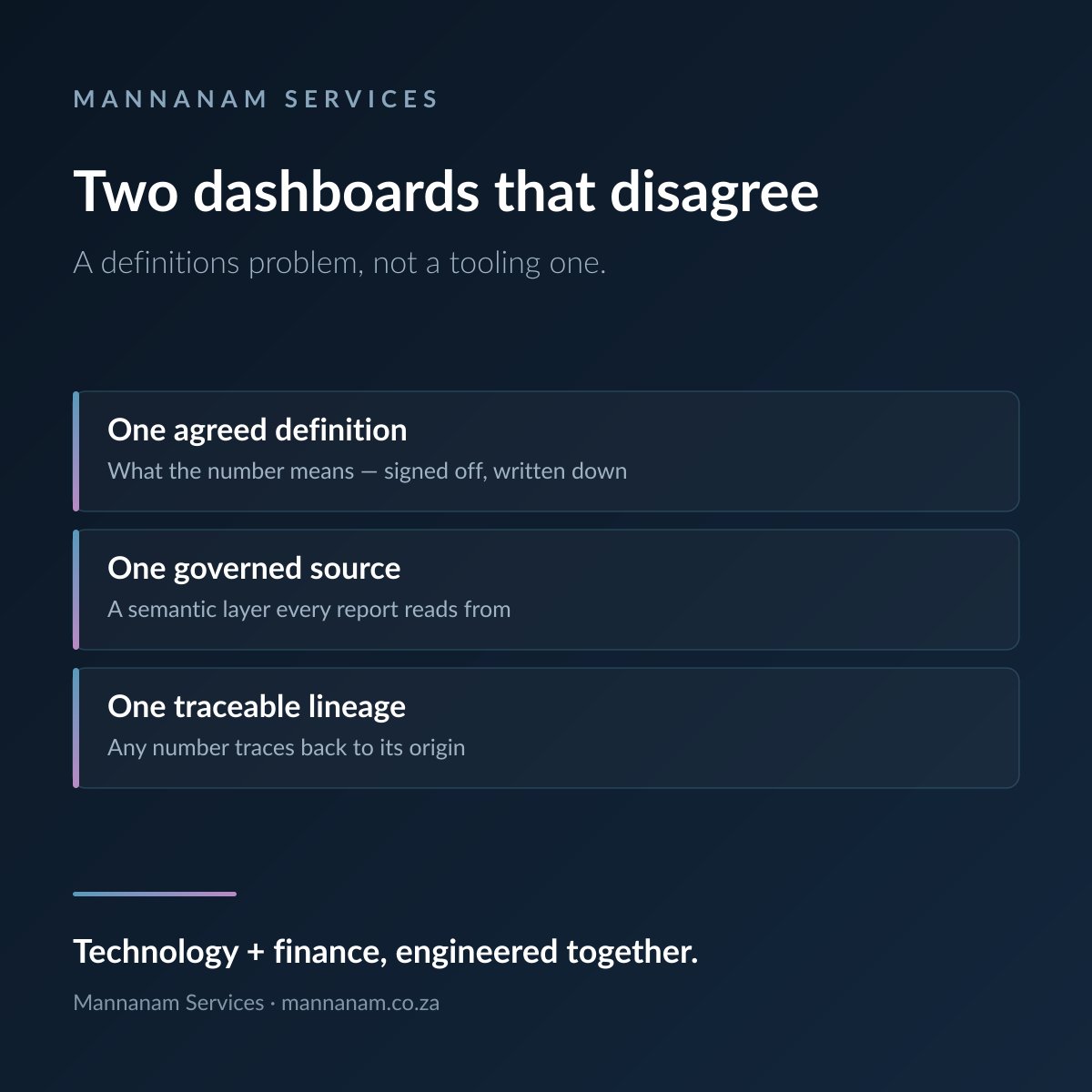
The fix is three unglamorous things
- A single agreed definition — what "revenue" means, signed off by Finance, written down, not assumed.
- One governed source — a modelled semantic layer the dashboards read from, so the calculation lives in one place instead of being re-implemented in every report.
- A documented lineage — anyone can trace a number back to where it came from, which is also exactly what an auditor will ask for.
No new platform. The tooling was fine all along. What was missing was the agreement underneath it.
The win isn't a prettier dashboard. It's meetings that start from a shared number — and a reporting layer an auditor can actually follow.